Omega Speedmaster Moonwatch: The Racing Chronograph That Went to the Moon
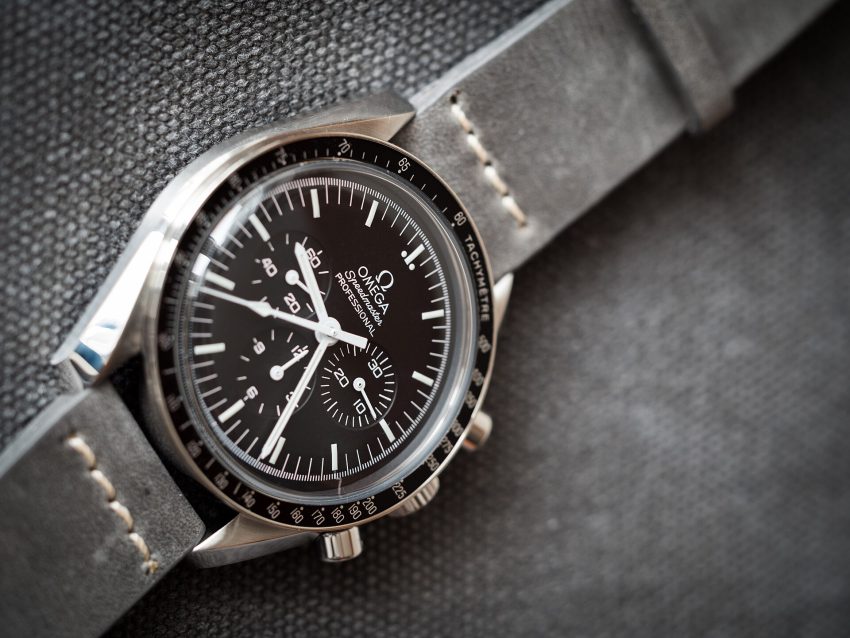
On July 20, 1969, Buzz Aldrin climbed down a ladder onto the Moon with a steel chronograph strapped over the sleeve of his spacesuit. That watch was an Omega Speedmaster Professional, and the remarkable thing is that you can still walk into an Omega boutique today and buy its direct descendant. Same 42mm asymmetrical case, same black dial with three sub-dials, same hand-wound movement you wind every morning. In this post we explain how a racing chronograph became the “Moonwatch”, what changed in the current reference 310.30.42.50.01.001, and who it actually suits.
Why the Omega Speedmaster Moonwatch Is Special
Plenty of watches have a good story. Very few have this one, and fewer still have stayed so close to their original design. Here is why the Speedmaster Professional matters:
- It passed NASA’s torture tests. In 1964 and 1965 NASA put several chronographs through heat, cold, vacuum, pure oxygen, shock and vibration. The Speedmaster was the one that came through, and it was selected in March 1965.
- It was on the Moon. Aldrin wore his Speedmaster during the first Moon walk in 1969, which makes it the first watch worn on the lunar surface.
- It has barely changed. The case shape, the dial layout, the domed Hesalite crystal and the hand-wound chronograph have carried through from the 1960s to today. The 2021 update gave it a modern Master Chronometer movement without changing the look people love.
1957: A Racing Chronograph, Not a Space Watch
The Speedmaster was never designed for space. Omega launched the first one, reference CK2915, in 1957 as a sports chronograph for racing drivers, sportspeople and engineers who needed to time things. It had broad arrow hands and a steel bezel engraved with a tachymeter scale, which lets you work out an average speed over a set distance.
Inside was the Calibre 321, a hand-wound column-wheel chronograph movement that beat at 18,000 vibrations per hour. That movement stayed in every Speedmaster through the 1960s, including the ones that went to the Moon. The CK2915 itself was made only from 1957 to 1959 before the CK2998 replaced it with a black bezel, a look much closer to the Moonwatch we know.
Space came by accident. On October 3, 1962, astronaut Wally Schirra wore his own personal CK2998 on the Mercury-Atlas 8 flight, called Sigma 7. NASA had not chosen it. Schirra simply liked his watch.
How NASA Picked the Speedmaster
You may have heard that a NASA engineer bought a handful of watches at a Houston jewelry store and tested them in secret. It’s a fun story, but the NASA engineer who ran the tests, James Ragan, later said it never happened that way. What actually happened was more official. NASA asked several watch brands to submit chronographs in 1964, and the testing ran until March 1, 1965.
The tests were brutal. The watches spent 48 hours at 160°F (71°C), sat in a near-vacuum, cycled between hot and cold, lived in 100% oxygen, and took six 40g shocks from different directions. According to Ragan, Rolex had trouble with heat and humidity, and the Longines watch lost its crystal and stopped. The Speedmaster passed, and NASA qualified it for its crewed missions.
Things moved fast after that. Gus Grissom and John Young wore the first officially issued Speedmasters on Gemini 3 in March 1965. In June 1965, Ed White made the first American spacewalk on Gemini 4 with a Speedmaster strapped to the outside of his suit sleeve on a long nylon strap with Velcro. Photos of that spacewalk did a lot to connect the Speedmaster with space in people’s minds.
Apollo 11 and Apollo 13: The Two Stories Everyone Tells
Here’s a detail many people miss: Neil Armstrong was first on the Moon, but his watch wasn’t. He left his Speedmaster inside the lunar module as a backup because the module’s electronic timer had stopped working. Aldrin chose to wear his, strapped around the outside of his spacesuit, so his became the first watch worn on the Moon. Both men’s watches were reference ST105.012. Aldrin’s was later lost when he sent it to the Smithsonian, and it’s still missing.
The second story is our favorite, because it’s about the watch doing a real job. In April 1970, an oxygen tank on Apollo 13 ruptured and the crew had to get home with much of their equipment shut down. They used a Speedmaster to time a critical 14-second engine burn that helped set them on course for a safe return. In October 1970, NASA gave Omega its Silver Snoopy Award, an honor for contributions to flight safety and mission success.
From the 105.012 to Today: The Moonwatch Generations
The watch you buy today is the result of a few careful steps rather than big redesigns.
105.012 (mid-1960s). This is the first Speedmaster with “Professional” written on the dial, and it introduced the asymmetrical case with guards that protect the crown and pushers. That shape is still the Moonwatch case today. Apollo 11’s watches were this reference.
145.012 and 145.022 (late 1960s). The 145.012 followed in the second half of the decade. Then, around 1968, the 145.022 swapped the Calibre 321 for the new Calibre 861. It used a cam instead of a column wheel and ran faster, at 21,600 vibrations per hour. Versions of that movement powered the Moonwatch for about 50 years, ending with the rhodium-plated Calibre 1861.
311.30.42.30.01.005 (2014 to 2020). The last Calibre 1861 Moonwatch with a Hesalite crystal. It’s the watch in our featured image, and you’ll still see plenty of them on the used market.
310.30.42.50.01.001 (2021 to today). In January 2021, Omega replaced the 1861 with the Calibre 3861. It is still hand-wound and still beats at 3 Hz, but it adds Omega’s Co-Axial escapement, a silicon balance spring and resistance to magnetic fields of 15,000 gauss. It is certified as a Master Chronometer by METAS, the Swiss federal metrology institute. Omega also brought back details from the 1960s references: a stepped dial, a dot over the 90 on the bezel, and a new five-link bracelet that tapers toward the clasp.
Put a 1966 105.012 next to a 2026 310.30.42.50.01.001 and the family resemblance is obvious. That continuity is a big part of the appeal. When you wear one, you’re wearing almost exactly what the Apollo crews wore.
Who Is It For?
The Moonwatch is a great pick if you love history you can wear every day. It’s a real tool chronograph, it goes with jeans or a suit, and the story behind it is true. There’s also something nice about the daily ritual of winding it. A full wind gives you about 50 hours.
Now the honest part. It is 42mm wide, 47.5mm from lug to lug and 13.54mm thick, so it wears bigger than some people expect. If you have smaller wrists, try one on, or look at something like the 39mm Tudor Black Bay 58 we covered last week. Water resistance is 50 meters, so it’s fine in the rain and washing up, but it isn’t a dive watch. The Hesalite crystal is the classic choice and looks wonderful, but it picks up scratches more easily than sapphire. And if you don’t want to wind a watch, you’ll probably prefer an automatic, such as the Grand Seiko Snowflake with its Spring Drive movement.
Like any mechanical watch, it needs a little care and a regular service. Our mechanical watch care guide covers the basics.
Omega Speedmaster Moonwatch Tech Specs
| Reference | 310.30.42.50.01.001 (Hesalite crystal, steel bracelet) |
| Case material | Stainless steel |
| Diameter | 42 mm |
| Thickness | 13.54 mm |
| Lug-to-lug | 47.5 mm |
| Lug width | 20 mm |
| Bezel | Black anodised aluminium tachymeter ring with dot over 90 |
| Dial | Black step dial |
| Crystal | Hesalite with OMEGA logo in the centre |
| Caseback | Solid, with embossed Seahorse medallion |
| Water resistance | 5 bar (50 m / 165 ft) |
| Movement | Omega Calibre 3861, manual winding, Co-Axial escapement, silicon balance spring |
| Frequency | 3 Hz (21,600 vph) |
| Power reserve | 50 hours |
| Certification | Master Chronometer (METAS), magnetic resistance to 15,000 gauss |
| Functions | Hours, minutes, small seconds, chronograph with 30-minute and 12-hour counters, tachymeter |
| Bracelet | Steel, foldover clasp with comfort setting |
| Weight | About 134 g |
| Price | US$7,800 (Omega US retail, October 2026) |
Omega Speedmaster Moonwatch FAQ
Is the current Moonwatch the same watch that went to the Moon?
Not exactly, but it’s very close. Apollo 11’s watches were the ST105.012 with the Calibre 321. Today’s 310.30.42.50.01.001 keeps the same case shape, dial layout and Hesalite crystal, with a modern Calibre 3861 inside.
What is the difference between the 311.30.42.30.01.005 and the 310.30.42.50.01.001?
The older 311.30.42.30.01.005 uses the Calibre 1861. The 310.30.42.50.01.001 from 2021 uses the Calibre 3861 with a Co-Axial escapement and Master Chronometer certification, and adds a step dial, a dot over 90 on the bezel and a new tapered bracelet.
Does the Speedmaster Moonwatch wind itself?
No. It’s a manual-winding watch, just like the originals. Wind the crown until you feel resistance and you’ll get about 50 hours of running time.
Do you wear a Moonwatch, or are you saving up for one? Tell us in the comments whether you’d pick the classic Hesalite or go for sapphire.
Featured image: Omega Speedmaster Professional Moonwatch ref. 311.30.42.30.01.005, the Calibre 1861 predecessor of the current model, photo by Daniel Zimmermann via Wikimedia Commons, licensed CC BY 2.0. Instagram photos are embedded from their owners’ accounts.
Leave a Reply