Cartier Tank Louis Cartier: How a 1917 War Machine Shaped the Perfect Rectangle
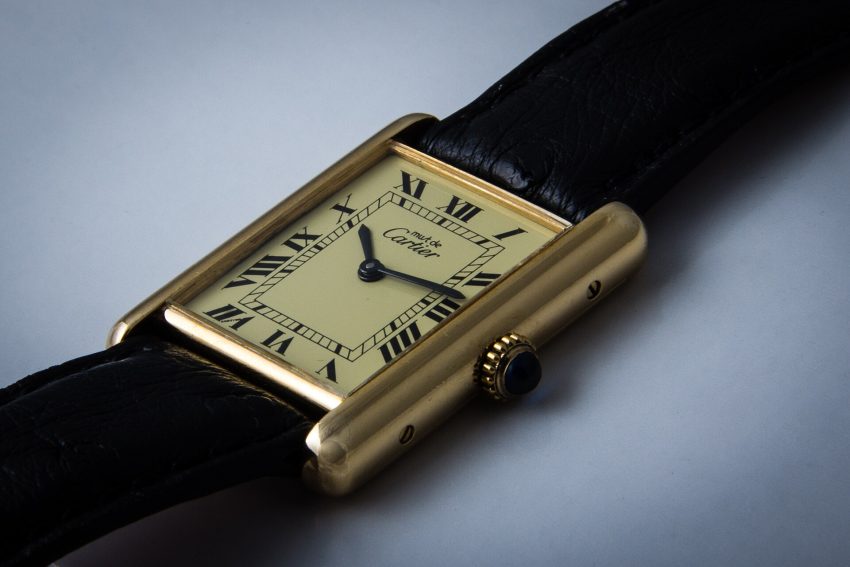
Most famous watches earn their reputation slowly: a record dive, a mountain, a moon landing. The Cartier Tank did it almost the other way round. It was sketched during the First World War, sold in tiny numbers, and then simply refused to go out of style for over a century. Today the Tank Louis Cartier is the version many people picture when they hear the word “Tank”: a slim gold rectangle, Roman numerals, blue sword hands and a little sapphire on the crown. Let’s look at where it came from, what makes it work, and who should actually wear one.
Why the Cartier Tank Louis Cartier Is Special
- It began with a big idea, not a small tweak. In 1917 almost every wristwatch was round. Louis Cartier drew a rectangle framed by two strong vertical sidebars, an idea he took from the tanks rolling across the Western Front.
- The 1922 version refined the shape. The Tank Louis Cartier kept the original’s proportions but softened it, with smoother edges and rounded lugs. That softer outline is the one Cartier still makes today.
- It has a real manufacture movement inside. The current large manual model runs on Cartier’s in-house hand-wound calibre 1917 MC, in a solid 18k gold case only 6.6 mm thick.
A Watch Born on the Western Front
Louis Cartier ran the Paris house, and several sources say he first imagined the Tank in late 1916 and finished the design in 1917. His inspiration was the new French tanks, the compact Renault FT, which were changing how the war on the Western Front was fought.
You can see the idea if you look at the watch from above. The two long sidebars, which watch people call “brancards”, run down each side of the case and flow straight into the strap. The case sits between them like the body of the machine. It looks obvious now, but at the time it was a radical way to think about a wristwatch: the case and the strap became one continuous shape.
There’s also a well-known part of the story involving General John J. Pershing, commander of the American forces in Europe. Wikipedia, Revolution and WorldTempus all report that a Tank prototype was presented to him. None of them gives a date or a document for it, so we treat it as Cartier lore rather than hard history, but it’s a nice link between the watch and the war that inspired it.
Six Watches, Then a Slow Burn
The Tank wasn’t a hit in the modern sense. It went on sale in 1919, and according to WorldTempus, just six pieces were added to Cartier’s inventory between mid-November and late December that year. All six had sold by the middle of January 1920. Revolution notes that fewer than 6,000 Tanks were made in the watch’s first fifty years. These were expensive, mostly handmade gold watches for a small circle of clients.
Then came the version this post is about. In 1922 Cartier introduced the Tank Louis Cartier. Revolution calls it the “ur-Tank” and describes perfect proportions, smooth edges and rounded lugs. Compared with the more architectural first Tank, it feels gentler on the wrist, and that is a big part of why it has aged so well.
Hollywood helped. Revolution points out that Rudolph Valentino wore a Tank in the 1926 film The Son of the Sheik. Over the decades the list of wearers grew into a who’s who of style: Jacqueline Kennedy, Yves Saint Laurent and Princess Diana are named by both Wikipedia and Revolution, and Andy Warhol is named by both Revolution and WorldTempus. Warhol famously said he didn’t wear his Tank to tell the time. He wore it because it was simply the watch to wear. That sums up the Tank’s appeal better than any spec sheet.
What Makes the Design Work
Strip the Tank Louis Cartier back and it’s a handful of simple choices, each done carefully:
- Roman numerals that follow the rectangle. They are stretched to fit the shape of the dial, so the numerals at the top and bottom look different from the ones on the sides.
- Blued steel sword hands on the classic silvered dial, which stand out clearly against the pale background.
- A beaded crown with a sapphire cabochon, a small Cartier signature you’ll find across the brand’s watches.
- A thin case. At 6.6 mm, it slides under a shirt cuff without a fight.
The size is the part that surprises people today. The large model measures 33.7 by 25.5 mm. On paper that sounds small next to a 40 mm sports watch, but rectangular watches wear differently from round ones. The length of the case and the way the brancards flow into the strap make it look bigger on the wrist than the numbers suggest.
The Tank Family and the Tank Louis Cartier’s Generations
The Tank quickly became a family. WorldTempus lists the Tank Cintrée (a long, curved version) in 1921, the reversible Basculante in 1932, the Tank Américaine in 1989 and the Tank Française, with its integrated bracelet, in 1996. In the 1970s the Must de Cartier line brought the Tank shape to a wider audience with colourful, mostly quartz “vermeil” watches in gold-plated silver. Sources differ on whether Must launched in 1970 or 1973, so we’ll just say the early ’70s.
Through all of this, the Tank Louis Cartier stayed the reference point. Recent years have brought the biggest changes to it in a long time:
- The 1917 MC manual movement. The current large manual models use Cartier’s hand-wound calibre 1917 MC: a small tonneau-shaped movement with 19 jewels, beating at 21,600 vibrations per hour, with about 38 hours of power reserve.
- New dials in 2022. At Watches & Wonders 2022 Cartier added graphic dials made of concentric rectangles: red lacquer in yellow gold (WGTA0093) and grey in pink gold (WGTA0092).
- A larger automatic in 2025. According to Swisswatches, Cartier presented a Tank Louis Cartier with the automatic 1899 MC movement at Watches & Wonders 2025, in a bigger 38.1 by 27.75 mm case.
For this post we’re focusing on the classic large manual model, reference WGTA0011: rose gold, silvered dial, Roman numerals, blued hands and a brown alligator strap. There is also a yellow-gold version with a black lacquer dial (WGTA0091).
Who Is It For?
The Tank Louis Cartier is for someone who wants one beautiful, quiet watch to wear with good clothes, and who likes the idea of owning a design with a century of history behind it. It works on almost any wrist, and it’s one of the few watches that has never really been “for men” or “for women”. It’s just a Tank.
Now the honest part. It’s water resistant to only 30 metres, so think of it as splash-proof, not a swimming watch. The manual movement needs winding every day or two. The strap is alligator leather, which doesn’t love heat, sweat or rain. And at around $14,800 it’s a lot of money for a watch without a date or any sporty features. If you want one watch for everything, including the beach and the gym, look at a diver instead. If you want the most elegant watch you can wear to a wedding, few things beat it.
If you’re still exploring, compare it with the other watches in our weekly series: the dressy, nature-inspired Grand Seiko Snowflake, the go-anywhere Tudor Black Bay 58, and last week’s green-dial Seiko Prospex Alpinist. For another watch with a famous origin story, read about the Omega Speedmaster Moonwatch.
Cartier Tank Louis Cartier Tech Specs
| Reference | WGTA0011 (large model, manual winding) |
| Case | 18k rose gold |
| Dimensions | 33.7 x 25.5 mm, 6.6 mm thick |
| Movement | Cartier manufacture calibre 1917 MC, hand-wound |
| Frequency | 21,600 vph (3 Hz) |
| Jewels | 19 |
| Power reserve | 38 hours |
| Crystal | Mineral crystal |
| Crown | Beaded, set with a sapphire cabochon |
| Dial | Silvered beaded dial, Roman numerals, blued steel sword hands |
| Strap | Brown semi-matte alligator, 18k rose gold ardillon buckle |
| Water resistance | 3 bar (30 m) |
| Price | US$14,800 excluding tax (USA, authorised dealer Wempe, November 2026) |
FAQ
Why is it called the Tank?
Louis Cartier designed it in 1917, inspired by the French tanks of the First World War. The two parallel sidebars on either side of the case are the design’s link to those machines.
What’s the difference between the Tank Louis Cartier and the Tank Must?
The Tank Louis Cartier is the 1922 shape with softer, rounded lugs, made in solid gold, with a manual manufacture movement in the large model. The Tank Must is the more accessible line, usually in steel, with quartz or solar options.
Is the Tank Louis Cartier too small for a man?
Not really. At 33.7 by 25.5 mm the large model wears bigger than its numbers, because rectangular cases cover more of the wrist than round ones. Plenty of men have worn it for a hundred years. If you want more presence, the 2025 automatic version is larger.
Do you own a Tank, or are you dreaming of one? Would you pick the classic silvered dial or something bolder? Tell us in the comments.
Featured image: a vintage Must de Cartier vermeil Tank, the 1970s take on the Tank Louis Cartier shape, by Guy Sie, via Wikimedia Commons, licensed CC BY-SA 2.0. Instagram photos are embedded from their owners’ accounts.
Leave a Reply