Seiko Prospex Alpinist: From Japan’s Mountain Trails to a Green-Dial Cult Classic
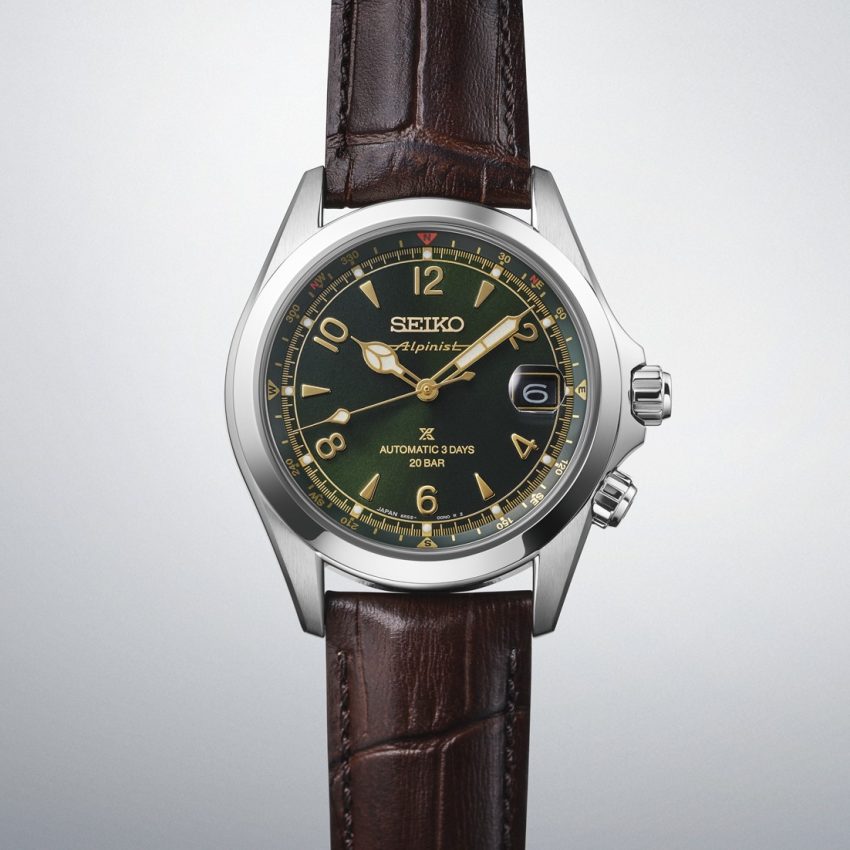
Ask a room of watch people to name the best “first proper mechanical watch,” and somebody will say Seiko Alpinist within about ten seconds. Green dial, gold numerals, two crowns, a little compass ring around the edge. It looks like it should come with a map and a thermos. And the funny thing is, that’s more or less exactly what it was built for.
The Alpinist started life in 1959 as a tough, readable watch for Japanese mountaineers. Today it’s Seiko’s mid-priced adventure watch, and in late 2025 it got its first real update in years: the green-dial Prospex Alpinist SPB507. Let’s look at why people love it, where it came from, and whether it’s the right watch for you.
Why the Seiko Alpinist Is Special
- It was Seiko’s first sports watch. Before the famous Seiko divers, there was the 1959 Laurel Alpinist. Seiko itself calls it the brand’s first watch made with sports in mind.
- It has a compass you can actually turn. The second crown at 4 o’clock spins an inner ring printed with compass bearings. It’s a simple tool, but it gives the watch a personality no plain field watch has.
- It’s a “real” watch at a sensible size and price. The SPB507 is 39.5 mm wide, 200 m water resistant, has sapphire crystal and a three-day automatic movement, and lists at $900 in the US.
1959: A Watch for Japan’s Mountain Men
Picture Japan in the late 1950s. The economy is growing, people have a bit more free time, and climbing and skiing are taking off. Seiko’s own history of the model says the first Alpinist was made for mountain climbers and people doing outdoor sports. aBlogtoWatch puts a nice name on that audience: the yama-otoko, or “mountain men,” who needed a watch they could read quickly and trust in rough weather.
The original was called the Laurel Alpinist, because it sat inside Seiko’s Laurel family. Honestly, it looked more like a dress watch than a tool. But it had the details that mattered on a mountain. Seiko lists them: a screw-back case to keep out dust and sand, a sturdy leather cuff strap that stood up to sweat, and luminous hands and markers so you could read it in the dark.
Our favorite detail is the hour markers. The markers at 3, 6, 9 and 12 had a mountain shape, and Seiko says they stood for the four points of a compass. The 12 o’clock marker was designed so you could read the time correctly at any angle, even with the watch tilted on your wrist mid-climb. Seiko notes that idea went on to shape many of its later sports watches.
In the early 1960s, the Alpinist moved into Seiko’s Champion line. Then, by the mid-1960s, it quietly disappeared. For almost three decades, there was no Alpinist at all.
1995: The Comeback That Gave Us the Look We Know
When the name returned in 1995, Seiko didn’t just revive the old watch. It reinvented it. Fratello’s history of the modern Alpinist describes how the dressy look was swapped for cathedral hands (those pointy, stained-glass-window shapes), a screw-down crown, 200 m of water resistance, and the feature everyone now associates with the Alpinist: a second crown at 4 o’clock that turns an internal compass ring.
Collectors call these 1990s models the “Red Alpinists,” because the Alpinist name on the dial was printed in red. They came in black, cream and green, and the dial layouts they set up have barely changed since. If you look at a 1995 green Alpinist next to a 2025 one, you’ll see the family resemblance straight away.
The Compass Ring, and the Mountaineer Behind a Special Edition
So what do you actually do with that compass ring? On the SPB507, the crown at 4 o’clock turns the inner ring, which is marked with N, E, S and W and degree numbers. Used together with the sun and the hour hand, a ring like this can give you a rough sense of direction, or you can simply line it up with a bearing to remind yourself which way you’re heading. Would we bet our lives on it instead of a real compass? No. But it’s a lovely thing to fiddle with on a train, and it ties the modern watch back to those compass-point markers of 1959.
The Alpinist’s mountain connection isn’t just marketing, either. In 2003, Seiko made a blue-dial limited edition with SSASS (Seven Summits Actions for Sustainable Society), an environmental group founded by the Japanese mountaineer Ken Noguchi. Fratello describes it as a rare charity piece, and when Seiko refreshed the Alpinist in 2025, the teal-dial SPB503 was inspired by that 2003 watch. It’s a nice reminder that real climbers have been part of this watch’s story for a long time.
From the Red Alpinist to the SPB507: The Generations
Here’s the short version of how we got from 1959 to today:
- 1959 – Laurel Alpinist. Seiko’s first sports watch, made for climbers. Later moved into the Champion line, then disappeared in the mid-1960s.
- 1995 – “Red Alpinist” (SCVF series). The modern look arrives: twin crowns, inner compass ring, cathedral hands, 200 m water resistance. The green SCVF009 is the ancestor of today’s green model.
- Mid-2000s – SARB series, including the SARB017. The green-dial SARB017 on brown leather became a cult favorite and a fixture on “best affordable watch” lists. Seiko announced its discontinuation in 2018.
- 2019/2020 – Prospex SPB121. The Alpinist joined Seiko’s Prospex sports line. The green SPB121 took over from the SARB017 with a sapphire crystal, a display caseback and the 70-hour 6R35 movement.
- 2025 – Prospex SPB507 (plus SPB503 and SPB505). The first update to the core line since it joined Prospex. New 6R55 movement with about 72 hours of power reserve, a case 0.5 mm thinner than before, and the Alpinist name back on the dial.
That last point is a small thing that fans cared about a lot. Fratello pointed out that the 2020 Prospex models didn’t say “Alpinist” anywhere on the watch. The SPB507 puts the script logo back under SEIKO, adds “3 Days” to the dial to flag the longer power reserve, and keeps the gold cathedral hands, the date window with a magnifier at 3, and the sunray green dial. Gear Patrol notes that the 6R55 first appeared in King Seiko a couple of years earlier, and it brings nicer rotor finishing that you can see through the caseback.
Who Is It For?
The Alpinist is a great fit if you want one mechanical watch that can do almost everything. At 39.5 mm across and 46.4 mm lug to lug, it wears comfortably on most wrists. It’s water resistant to 200 m, so swimming and rain aren’t a worry. The green dial and brown leather strap look as good with a flannel shirt as with a blazer. And the compass ring gives you something fun to play with that a plain three-hander doesn’t.
Now the honest part. The 6R55 is a dependable workhorse, but Seiko rates it at +25 to −15 seconds a day. That’s fine for daily life, but it’s not chronometer accuracy, and some watches in this price range do better. The SPB507 also costs more than the SPB121 did, and the dial is busy: numerals, triangles, a compass scale, a date and a magnifier all share the same space. If you like very clean dials, this isn’t your watch. And if you mostly wear your watch on a bracelet, note that the green SPB507 comes on leather; the black SPB505 and teal SPB503 are the bracelet models.
If you’re weighing up other “one watch” options, have a look at our deep-dive on the Tudor Black Bay 58, a 39 mm diver at a higher price. For more Japanese craftsmanship from Seiko’s luxury side, read our Grand Seiko Snowflake story. And once your Alpinist arrives, our mechanical watch care guide will help keep it running well.
Seiko Alpinist SPB507 Tech Specs
| Reference | SPB507J1 (Prospex Alpinist, green dial) |
| Case material | Stainless steel with super-hard coating |
| Diameter | 39.5 mm |
| Lug-to-lug | 46.4 mm |
| Thickness | 12.7 mm |
| Lug width | 20 mm |
| Weight | 88 g |
| Crystal | Sapphire with date magnifier, anti-reflective coating on inner surface |
| Caseback | Screw-down, see-through |
| Crown | Screw-down; second crown at 4 o’clock turns the inner compass ring |
| Water resistance | 20 bar (200 m) |
| Magnetic resistance | 4,800 A/m |
| Movement | Seiko Caliber 6R55, automatic with manual winding, 24 jewels, hacking seconds |
| Power reserve | Approx. 72 hours |
| Accuracy | +25 to −15 seconds per day |
| Lume | LumiBrite on hands and indexes |
| Strap | Cow leather with three-fold clasp and push-button release |
| Price | USD 900 (Seiko USA official site, October 2026) |
Seiko Alpinist FAQ
What’s the difference between the SPB121 and the SPB507?
Both are green-dial Alpinists on brown leather. The SPB507 replaces the SPB121 with the newer 6R55 movement (about 72 hours of power reserve instead of 70), a case that’s 0.5 mm thinner, and the Alpinist name back on the dial. It also costs more.
How does the compass on the Seiko Alpinist work?
The crown at 4 o’clock turns an inner ring marked with compass points and degrees. Used with the sun and the hour hand, it gives a rough idea of direction. It’s handy and fun, but it’s no replacement for a real compass when it matters.
Is the Seiko Alpinist a dive watch?
No. It’s 200 m water resistant with a screw-down crown, so swimming is no problem, but it’s an outdoor and field watch. It doesn’t have a diver’s timing bezel; its rotating ring is a compass.
Do you own an Alpinist, old or new? Is it the green one, or did you go for black or teal? Tell us in the comments. We’d love to hear where yours has been.
Featured image: Seiko Prospex Alpinist SPB507J1, official product image by Seiko Watch Corporation. Instagram photos are embedded from their owners’ accounts.
Leave a Reply