Casio G-Shock DW-5600: The Watch Born From a Bouncing Rubber Ball
Most watches ask you to be careful with them. Don’t drop it, don’t knock it on a door frame, don’t wear it while you move furniture. The Casio G-Shock 5600 was built on the opposite idea. It’s a small black square of resin that costs about a hundred dollars, and it was designed from day one to be dropped, banged, soaked and generally mistreated.
It’s also one of the most recognisable watches ever made. The shape you see on today’s DW5600UE goes straight back to the very first G-Shock of 1983, and the story of how that shape came to be involves a bathroom window, a park full of kids, and an engineer who was ready to quit. Let’s get into it.
Why the G-Shock 5600 Is Special
- It’s the original shape. The 5600 keeps the octagonal case of the very first G-Shock, the DW-5000C. Casio describes that form as the natural result of chasing toughness and nothing else, and it has barely changed in more than four decades.
- The toughness is in the structure, not just the material. The electronic module “floats” inside a hollow resin case, touching it only at a few points, so a hard knock doesn’t travel straight into the parts that keep time.
- It does a lot for very little money. 200 metres of water resistance, a 1/100-second stopwatch, a countdown timer, alarms, a backlight and a calendar that runs to 2099, all for $99.95 in the US.
One Line on a Piece of Paper
In the early 1980s, Kikuo Ibe was a young designer at Casio working on watch exteriors. According to Casio’s own telling, his proposal at a company meeting contained a single line: a durable watch that would not break even if dropped. The idea came to him after a watch he had dropped at work broke.
That sounds obvious now. Back then it wasn’t. Watches were treated as delicate precision instruments, and everyone simply accepted that dropping one meant a trip to the repair shop. Ibe’s proposal was approved anyway, and a small group called Project Team Tough started work.
Ibe set the team a goal he called “triple 10”: survive a 10-metre fall, resist water to 10 bar, and run 10 years on a battery. The first of those turned out to be the hard one.
The Bathroom Window and the Rubber Ball
The early testing was wonderfully low-tech. Ibe would throw prototypes out of a third-floor bathroom window at Casio’s R&D centre and onto the ground about 10 metres below. Then he’d pick up the pieces, work out what had broken, strengthen it, and throw it again.
The first instinct was to wrap the whole watch in soft rubber. It didn’t work. No amount of padding on the outside stopped the insides from breaking, and the more cushioning they added, the bigger the watch got. Casio says one test model ended up the size of a softball. Even after the team got the size under control, they kept hitting the same wall: fix one part, and the next drop would break a different one. By Nippon.com’s account, the project went through more than 200 prototypes in two years.
Ibe gave himself one last week to crack it, and he was seriously thinking he might have to leave the company if he failed. On the Sunday at the end of that week, with nothing to show for it, he walked into a park next to the office and watched some children playing with a rubber ball.
That was the breakthrough. If the heart of the watch could float inside the case, like something suspended inside a rubber ball, it would be protected from the shock of a hit. Instead of armouring the module, the team suspended it inside a hollow case so that it touches the case only at a few set points. Casio still calls this the hollow case structure, and it remains the foundation of every G-Shock.
The case does its part too. Casio points out that the raised edges of the case and bezel stand proud of the buttons and the glass, so a knock usually lands on resin rather than on the parts that can break. The strap also curves away from the case where it attaches, which keeps the case back from taking a direct hit.
A Slow Start, Then a Hockey Puck
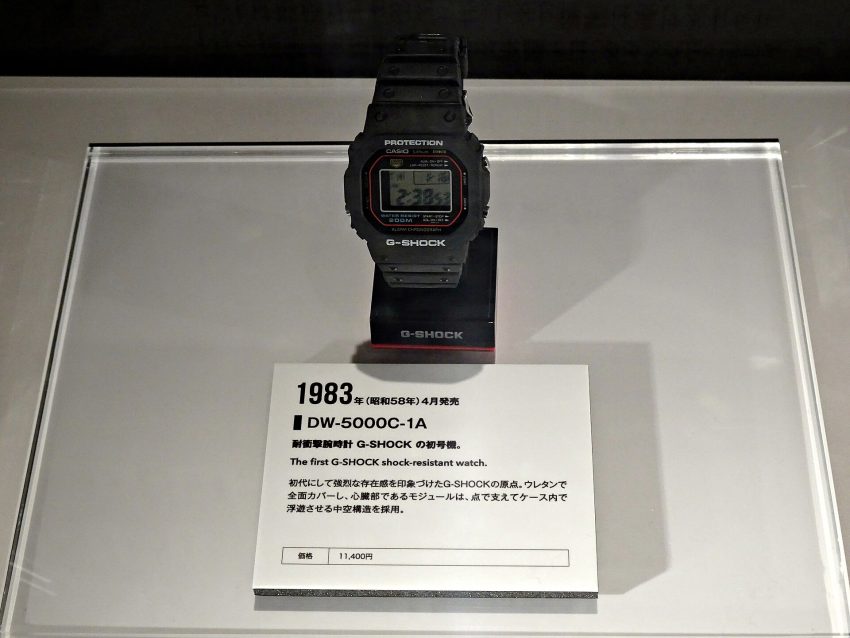
The first G-Shock, the DW-5000C-1A, went on sale in April 1983 at ¥11,400. Japan wasn’t impressed at first. Thin dress watches were the fashion, and Ibe has said that some watch sellers weren’t keen on a watch that wouldn’t need repairs, since repairs were good business.
America was a different story. Casio’s US team made a TV commercial in which an ice hockey player slapped a G-Shock into a goalie’s glove like a puck. Plenty of viewers assumed it was a trick, and news programmes recreated the stunt on air to check. The watch survived, and sales took off. Casio liked the ad so much that it recreated it years later for the modern 5600.
From there, G-Shock grew into something Ibe never expected. In the 1990s it became part of skate, surf and street fashion, first in the US and then back home in Japan. By 2017 Casio had sold its 100 millionth G-Shock, and Nippon.com reported more than 130 million by 2021.
From DW-5000C to DW5600UE: The Generations
The “5000” and “5600” names cover a big family now, from $99 resin watches to full-titanium MR-G pieces costing thousands. Here’s the short version of the line that leads to the watch most people mean when they say “a 5600”.
DW-5000C (1983). The original. It used a metal inner case and a screw-down case back, and its display was framed in red. That’s the model in the photo at the top of this post.
DW-5600C (late 1980s). Same shape, same screw-back construction. This is the “Speed” G-Shock: Keanu Reeves wears one throughout the 1994 film, and it’s one of the most famous on-screen appearances the brand has had. The DW-5600C and the later DW-5600E are also listed as flight-qualified by NASA for space travel.
DW-5600E. The long-running everyday version that many of us grew up with. It swapped the screw-back for a simpler case back and added an electro-luminescent backlight, with about two years of battery life on a CR2016 cell. Casio US now lists the DW5600E-1V as discontinued.
DW5600UE (today). The current standard model looks almost the same, but it replaces the old backlight with a bright white LED and stretches battery life to about five years on the same CR2016. Casio describes it as having “the look of the past but modern tech under the hood”, which is about right.
Here’s the evolution side by side: a DW-5600C on the left and a current DW5600UE on the right. Same shape, same layout; the newer one swaps the screw-back construction for a simpler back and adds the “Illuminator” LED light.
Along the way, Casio has used the same square shape to show off almost every technology it has: solar charging, radio time signals, Bluetooth phone pairing and full-metal cases. The GW-M5610 adds solar power and radio-controlled time, and the GMW-B5000 puts the whole thing in steel. But the plain resin 5600 is still the one that defines the look.
Who Is It For?
Pretty much anyone who wants a watch they never have to think about. It’s great as a beach, gym, travel or work-site watch, and plenty of collectors with expensive mechanical pieces keep one in the drawer for the days they don’t want to worry. At 52 grams and 13.4 mm thick, you barely notice it on the wrist, and the case is only 42.8 mm wide, so it suits smaller wrists better than you’d expect from a “tough” watch.
Now the honest part. It’s a quartz digital watch in a resin case, so if you love watching a sweep seconds hand or looking at a movement through a sapphire case back, this won’t scratch that itch. The glass is mineral rather than sapphire, so it can pick up scratches. The plain DW5600UE also doesn’t set itself by radio or Bluetooth, and Casio rates it at ±15 seconds a month, so you’ll be correcting it every so often. If that bothers you, look at the solar GW-M5610 family instead.
If you want a mechanical watch with a similar “wear it anywhere” attitude, our post on the Hamilton Khaki Field Mechanical is a good next read. Curious how a watch earns a place in space history the hard way? Read about the Omega Speedmaster Moonwatch. And if you’re wondering how the 5600’s 200 metres compares with a serious dive watch, the Rolex Submariner Date is rated to 300.
Casio G-Shock DW5600UE-1 Tech Specs
| Reference | DW5600UE-1 (successor to the discontinued DW5600E-1V) |
| Case size (L × W × H) | 48.9 × 42.8 × 13.4 mm |
| Weight | 52 g |
| Case and bezel | Resin |
| Band | Resin; fits wrists of about 145 to 205 mm |
| Glass | Mineral glass |
| Construction | Shock resistant |
| Water resistance | 200 metres (20 bar) |
| Power | Quartz; CR2016 battery, approx. 5 years |
| Accuracy | ±15 seconds per month |
| Light | White LED backlight (Super Illuminator) with afterglow |
| Functions | 1/100-second stopwatch, 24-hour countdown timer with auto-repeat, multi-function alarm, hourly signal, flash alert, full auto-calendar to 2099, 12/24-hour format |
| Price | US$99.95 (Casio US official store, November 2026; listed as “Notify me” when checked) |
FAQ
What’s the difference between the DW5600E and the DW5600UE?
They look almost identical. The newer DW5600UE swaps the old electro-luminescent backlight for a white LED and more than doubles the battery life, from about two years to about five on the same CR2016 cell. Casio US now lists the DW5600E-1V as discontinued and points buyers to the DW5600UE-1.
Can you swim and dive with a G-Shock 5600?
Swimming, surfing and showering, yes. It’s rated to 200 metres, and Casio specifically mentions swimming, surfing and jet skiing as fair game. It isn’t a certified dive watch, though, and it has no rotating dive bezel, so serious scuba divers usually wear a dedicated dive watch or computer.
Is the 5600 the same as the first G-Shock?
It’s the direct descendant. The first G-Shock was the DW-5000C of 1983, and the 5600 keeps its octagonal shape and float-mounted module. The big differences are inside: newer modules, a better light and longer battery life. The original also had a metal inner case and screw-down back, which the basic resin 5600 doesn’t.
Do you own a 5600, or a G-Shock that has survived something it really shouldn’t have? Tell us about it in the comments. We’d love to hear your stories.
Featured image: the first G-Shock, DW-5000C-1A (1983), on display, by ブルーノ・プラス via Wikimedia Commons, licensed under CC BY 4.0. Instagram photos are embedded from their owners’ accounts.

Leave a Reply